Archives

All posts for the year 2012

The three main protagonists of this anime.

Today’s post marks the start of the audition searching for this blog’s ‘Anime of the Year 2012’ inaugural winner. Actually, I want to only start this audition once the 2012 spring season ends, but because I cannot wait to watch Daily Lives of High School Boys for reasons that will be detailed below, I started the audition early. Because of this, there are only four titles in the audition, and they are Nisemonogatari, Papa no Iu Koto wo Kikinasai!, Another and of course, Daily Lives of High School Boys that will be reviewed today.

A beach episode. Obviously it is nowhere as good as the outstanding Highschool of the Dead OVA.

Story:-
The two main protagonists, alongside a secondary character sidekick, are 2nd year students in a normal all-boys high school somewhere in Japan. Permanently trapped in that class ala Urusei Yatsura, the three characters does their daily own stuff in and outside the school, between each other, between them and their own schoolmates, plus their own families and students from other schools too.

This plot-less comedy anime is suspiciously similar to another anime that involves plenty of high school boys, titled Sakigake!! Cromartie Koukou a.k.a Cromartie High School. Both of them are comedies and features male high school students, mostly in high school settings. Don’t even bother trying to find anything that resembles plot in here, this anime is one of those titles that that are purely driven by character strengths and the humor.

The comedy in this anime is great, just like what you can see in Cromartie Koukou. But if those two’s comedies quality are compared, I think Cromartie Koukou will still edge ahead of this anime in this regard. Just like Cromartie Koukou, this anime is also a dialogue-heavy anime, but this anime has the distinction of having far more action in it. Just so you know, Cromartie Koukou is set up at a delinquent-only all-boys high school, yet that anime has almost zero violence in it. In this anime, set up at a normal all-boys high school, punching people as a response of being at the wrong end of a joke is a very common event in this anime.

The ending of one of the best comedy arcs in this anime.

Another thing these this anime has in common with Cromartie Koukou is parodies and references to external sources, especially for Square Enix (where the source manga was published) and Sunrise (the studio that produced this anime) intellectual properties, amongst others. No DiGi Charat though in here, although Mahou Shoujo Madoka★Magica can be glimpsed. This anime is markedly different from Cromartie Koukou in one aspect though, and that would be the existence of a bunch of recurring FEMALE characters throughout the this series. Those characters from the opposite sex do enhance this anime in ways that Cromartie Koukou will never be able to experience. For example, characters in Cromartie Koukou can never talk about how to get girlfriends…

The three main protagonists and the best characters in this series, all of them MALE high school students, are central elements of this anime, after all they have the most airtime and are involved in almost all arcs in this anime. The central main protagonist (the one at the center in the top-most screenshot above) has his airtime cut severely in the final third of the anime, and that’s why I downgraded him to the sidekick status in the synopsis in the first paragraph above. Due to the nature of this anime, character developments in this anime is almost non-existent, with almost all of the characters in this anime is virtually the same between the start and the last episode. The three characters are also backed up by many good secondary characters, from the high school itself or from within the characters’ households. Even the aforementioned recurring female characters has done well, most of them anyway like the ‘High School Girls Are Funky’ characters and also the student council president from the all-girls high school.

This side show at the end of each episode is quite good too, gives the main series a run for its money.
This side show at the end of each episode is quite good too, it managed to give the main series a run for its money.

This anime has the Azumanga Daioh’s storytelling method, where each episodes contained small arcs that is several minutes long. Therefore the pacing is fast just like what you can see in Seitokai Yakuindomo that uses the 4-koma manga storytelling method in its anime version. This anime minimized the negative effects of using such a storytelling method by not only keeping arcs in the same themes together more often than Seitokai Yakuindomo is, arc pairing method is also used where one given arc will be followed by another arc that will use the context from the previous one. It also helps that the arcs in this anime is longer too than the ones in Seitokai Yakuindomo. Transitions between distinct arcs are largely seamless too but not perfect, considering the storytelling method this used.

The ending is open-ended, setting up nicely for a second season. The only drawback about the ending is that the arc is one of the weakest arcs in the whole series, mainly because the anime tried to step out of its comedy genre and having some melodramatic scenes in it. Somehow, the way the last episode being presented reminds me of Hayate no Gotoku. When was the last time I’ve seen a last episode that isn’t one?

Just one of the humor in this anime, that is not possible at all in the likes of Cromartie Koukou.

Character Design:-
Definitely different from what you can see in Cromartie Koukou for sure. In Cromartie Koukou, 95% of the characters has that ‘wild’ looks that makes little kids cry, while only 5% of the characters in this anime has it. And to think that violence is more common in the latter. In general, character designs in this anime is is much typical for a shounen though. There is implicit acknowledgement that hair dyes are used by characters in this anime so I’ll overlook all of those blond and yellow-haired and purple-haired characters. Not bad but not outstanding either.

Voice Acting:-
The quality of voice acting in this anime is grossly uneven. Amongst the three main protagonists, one of them (the bespectacled guy) has done an excellent job, another one (the central protagonist turned sidekick) is mostly decent while the blonde guy is just barely above average. As for their schoolmates, their families and also the female characters, the quality also vary widely. The two student council presidents, the bearded guy from the main protagonists’ class and his older sister, and the bespectacled girl and the Archdemon from the ‘High School Girls Are Funky’ skits also has excellent voice acting gigs.

Want to know how those three characters ends up on the ground? Watch this seriesd then!
Want to know how those three characters ends up on the ground? Watch this series then!

Music:-
This anime has also done pretty well in this aspect. The OST is decent, but too sparse for my liking. If the dialogue-heavy Seitokai Yakuindomo can have a great soundtrack, I don’t really see this anime that has similar presentation cannot have it. The ED theme is below average, but the OP theme and the insert in 3rd episode are quite good.

Animation/Direction:-
This anime used the blurry animation technique here (just like in Sunrise’s Sacred Seven), usually in slow-paced scenes, the reverse of the application seen in Cardfight!! Vanguard. A point will be deducted from the final evaluation then. Apart from that, the animation quality is not exactly good, especially in laid-back slow-paced scenes. Compared to the recent two Sunrise titles reviewed here before, Sacred Seven and Tiger & Bunny, the inferiority of the animation quality here is really apparent. Despite the delicious amount of violence in this anime, choreography doesn’t really apply to this comedy title. The director has done a good job too, especially for minimizing the negative effects of this anime’s storytelling technique.

Conclusion:-
7 out of 10.
This anime was suggested to me by some of my Left 4 Dead 2 game friends, and I will recommend it to anyone who likes comedy titles too. My friends sure has some strong attachments to the literature girl (that is crap) and the ‘High School Girls Are Funky’ skits though…

Quoted for Truth!
Quoted for Truth!

Shortlink: http://wp.me/prgSo-xU


The blue-haired main protagonist. His name is not Kai though.

Cardfight!! Vanguard is a series I’ve glimpsed in a satellite channel I’ve subscribed to but rarely watched, Animax Asia. From the few episodes I’ve watched, I decided to get the whole shebang and watched it from the start to the finish, all 65 episodes of them. This is a 2011 title, therefore it will challenge Tiger and Bunny for the ‘Anime of the Year 2011’ title, but this series’ quest for glory will be made harder because the sport genre standard handicap will be applied here.

This series has a beach episode too. I wonder if it can be mentioned in the same breath as the Highschool of the Dead OVA is.

Story:-
The deep-blue-haired main protagonist has the hots for the brunette Toshiki Kai, a person who saved  him from his suicidal tendencies a few years back. The latter is a very lucky skillful at this thing called Vanguard card game, therefore the main protagonist decided to learn the said game too from the scratch so that the love of his life will look at him. He have to act fast though, because slowly and surely, the brunette is falling into the arms of a surly, yet beautiful white-haired card shop girl. As the main protagonist works hard at sharpening his skills in playing the Vanguard card game, he started to hear strange voices…

Vanguard is just a card game, yet it attract many shady participants...
Vanguard is just a card game, yet it attract many shady participants…
...as well as quirky ones.
…as well as quirky ones.

For the purpose of this review, knowledge of how the card game works is essential, but I don’t really feel like explaining them. What is important for you to know is how a match’s result usually decided though. In the Vanguard card game, in almost all scenarios, when the competing two players are roughly equal in skills, tactics’ execution and deck constructions, the result will always be determined on which player has the most luck when it comes to drawing trigger cards. Actually, this anime even admitted it as such. In other words, luck plays a hugely disproportionate role in determining a match’s result. Skills only comes to the fore only if the participants isn’t on the same level (skill + tactic + deck construction), an occurrence that is not exactly common in this title.

What this means here is that the major directions of the storyline are determined by the most important plot device in this series: the 4 Vanguard trigger cards. Personally, I think the writer uses this plot device very well to steer the direction of the main plot the way he/she wanted it. As you may suspect, the trigger cards is a fertile source for deux ex machina moments (the third battle of the finale is such a fine example of this) but the writer really minimized the damage that such moments can do to the series.

OMG!! DRAMA!
OMG!! DRAMA!

As for the story itself, it is quite decent but not exactly a masterpiece. It is your standard ‘I wanna be stronger’ plot common for the genre if when its protagonist is a complete newbie at the start of the series. What grates me about the storyline the most is the existence of a couple of forced drama scenes (an example can be seen in the above screenshot) and also the tendency to insert flashbacks exactly at junctures where it isn’t needed. The latter in particular has the additional effects of disrupting the flow of the plot and also slowing down the pacing, at a time when the pacing should have been quicker. And I do mention that the flashbacks are annoying right?

While the pacing in the general storyline of this anime could have been much, much better, the in-game and in-tournament pacing is largely excellent, with only some minor blips. Thankfully, those scenarios makes up the majority of this anime. Unnecessary match-ups are not shown at all, especially those that didn’t involve the main protagonist and/or his team. Matches with less importance in it that involves him or his team are done quickly too, ensuring that the pacing didn’t suffer. More airtime is given on important matches, appropriately so. And as mentioned before, the flow of the storyline has been affected by those flashbacks thingy, and this actually affect both in-game/in-tournament moments as well as the portions outside of them. This anime has a second season; hopefully this aspect can be improved in the sequel.

As for character development, a sport genre title will almost always excels in this aspect especially if the main protagonist is a complete n00b in the game that are being portrayed. The same can also be said here, with the blue-haired main protagonist being the best character with his extremely extensive character development. The aforementioned surly white-haired card shop girl is another character that is almost on the same level as the main protagonist, while the latter’s love of his life is the sore exception in the team with his nearly static character development. The ending is decent and admittedly predictable, and it is written to accommodate a second season that is already airing. I wonder if Animax Asia will have that one or not.

This anime need less of this shit...
This anime need less of this shit…
...and more of the fast-paced national tournament goodness.
…and more of the fast-paced national tournament goodness.

Character Design:-
Character design in this anime is just your common shounen genre designs, orthodox ones if you ask me. Therefore, do not expect to see many black-haired characters in this anime set up in card-crazed modern Japan. Instead, the manufacturers of hair dyes are swimming in mountains of yen as people with blue hairs or white ones or more commonly, many shades of brown makes up the majority of the characters in this anime.

Voice Acting:-
The quality of voice acting in this anime is uneven. The blue-haired main protagonist and his black-haired future brother-in-law is just average, while the brunette and the white-haired card shop girl is just a little bit better than them. Three outstanding voice acting jobs in this anime belongs to the main protagonist’s little sister (has orange hair – dammit, it is orange), the redhead antagonist and also Daimonji Nagisa (another brunette). Thinking about that, the main protagonist sure sound better when he is in that SEED mode!

Music:-
This anime has done really well in this aspect. Not only the OST is decent, but the majority of the OP and ED themes are actually good. After the below average 1st OP and ED themes, all themes that follows them (2nd OP theme and 2nd, 3rd and 4th ED themes) are actually good.

The blurry animation technique in action in this anime.

Animation/Direction:-
This anime used the blurry animation technique extensively throughout the series as illustrated in the screenshot above, mostly in fast-paced scenes. Therefore, one point will be docked from the final evaluation of this anime.

Another complaint I have for this anime in this aspect is the poor character animation quality. I mainly refer to its atrocious character animation frame rate, which can be likened to a slide-show at its worst. This happens mostly outside card battles though, and not in them.

Non-character animation quality is good, and so is the overall animation in in-game matches, even in fast-paced scenes. Choreography is just average though, what do you expect from a card game anime? The director can be credited for not resorting to the potentially finicky CGI animations and pacing management in in-game events. The staggered flow of the storyline is another matter though.

Conclusion:-
5 out of 10
. The various handicaps this anime has really drag a reasonably enjoyable sport genre title down. Tiger and Bunny passed its second consecutive challenge very nicely as a result.

Speaking about music, if I am the manager in charge of this idol group, I will make them go to plenty of choreography classes. This is definitely the worst idol group in anime history.

Shortlink:


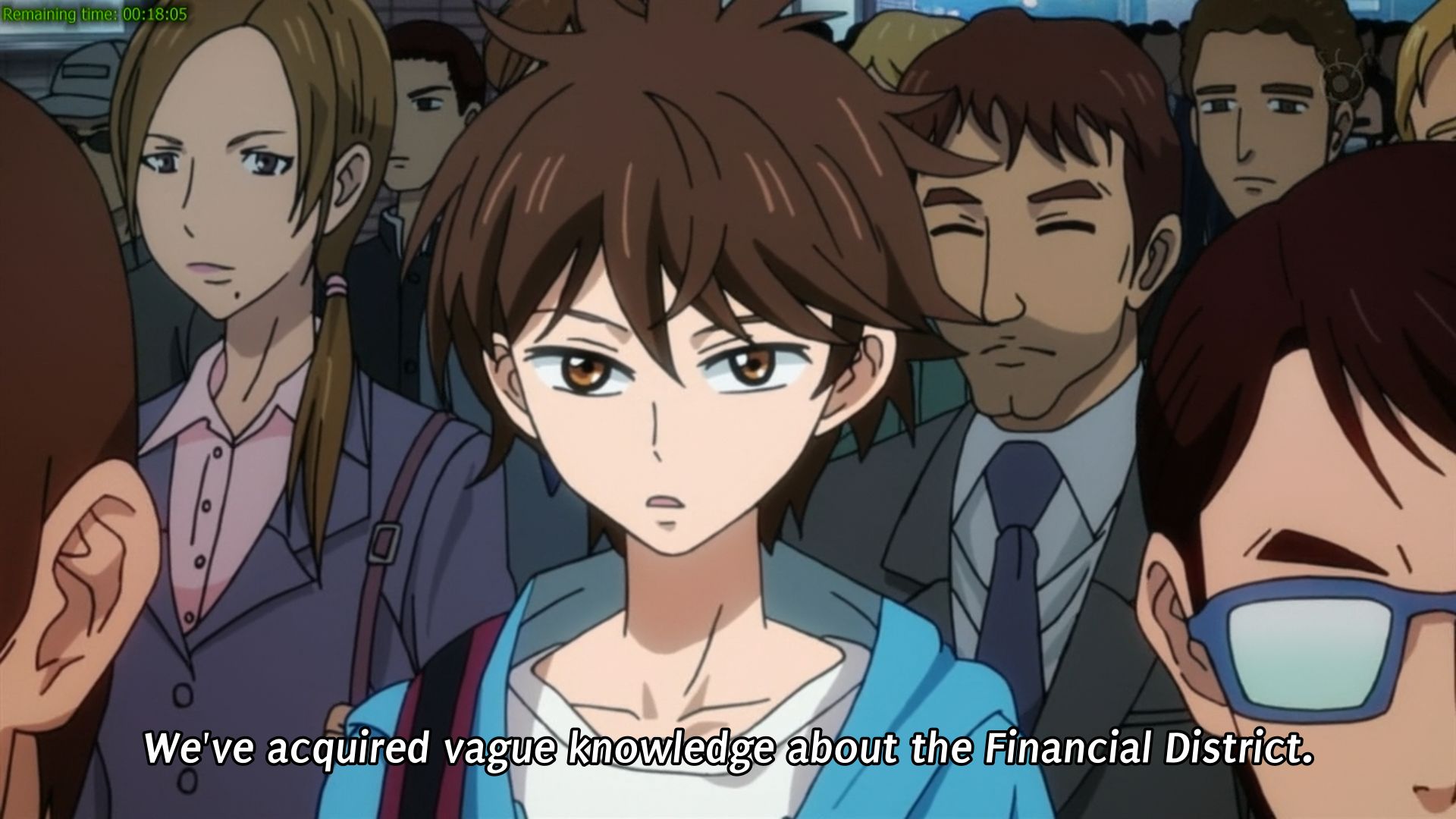
The main male protagonist, holding the fort for Milton Friedman on behalf of International Monetary Fund. IMF in this anime sure is different than the one in real-life.

Tiger and Bunny has just managed to win the ‘Anime of the Year 2011’ title in the last post, and today it has to defend the title against yet another 2011 anime series that I have decided to watch, titled C – The Money of Soul and Possibility – Control. This anime features a never-seen-before concept as the core of its plot, and this results in this anime's failure to unseat Tiger and Bunny’s reign after only one post.

Story:-
Set up in Japan that is under economic and social disarray, our equally struggling main protagonist was randomly selected by a mysterious clown-like person to participate in a series of battles taking place in an alternate dimension. The prize for winning (or not losing too heavily) is money, with his ‘future’ being put up as the collateral for participating in those battles. After winning his first battle completely by pure luck, the main protagonist met with one of veterans of the said game, who seems to be oddly interested in him (not THAT way though).

Take a few characters from the .hack//G.U series (plus significant amount of its plotline), transplant them in a Gantz-like world (use many of its technical structures), then add a couple of plot devices from the Cardfight!! Vanguard anime (the card and the avatar for example), and you will get an anime series that has plenty of battles. But instead of having a ‘save the world’ or ‘good vs. evil’ plots, this anime features prominently a thinly-veiled war between Milton Friedman and John Maynard Keynes macroeconomic principles, where the stake is the existence of Japan itself.

This is where the first weakness of this anime will become more apparent. Unless you are well-versed with both of those two luminaries’ economic principles, there are chances you won’t get to fully understand this anime’s storyline. It can be argued that having the clash between two important economic principles in the plot  can make a great storyline, but the risk of making the storyline itself inaccessible because of that is also high. I vastly prefer the way Wolf and Spice does its business, where its microeconomic principles are explained and integrated in its storyline in a way that even a dumb-ass can understand and enjoy. There are reasons why the two seasons of Wolf and Spice do get the perfect score designation after all.

Considering that I do know how the two macroeconomic principles works in general, I do thoroughfully enjoys this series. The usage of plotlines lifted straight from .hack/G.U. (the little sister sub-plot pretty much confirms it) and combined with the aforementioned clash between economic principles, this results in a pretty solid anime title. The pacing of the storyline is excellent, but  there are some problems with flow of the story due to repeated use of Katanagatari-esque off-screen battles. What I don’t really like in this anime is that sometimes it shows the main protagonist preparing to battle a foe at the end of an episode, then when the next episode plays, no results from the said battle is being conveyed to the audience at all.

The other weakness of this anime is the ending. Just to make it clear here, this anime’s ending by itself, is quite good, despite being inherently predictable. But some minor plotholes remains after the final episode stopped playing, an example being the like the outcome of the battle between the IMF mole in the guild and one of main antagonist’s lieutenants. This anime is the kind that need the kind of ending that Kore wa Zombie Desu ka? has the most; a complete episode dedicated solely for the aftermath. I think there is a series that does exactly just that, but I cannot remember which one. The paltry 2 minutes airtime dedicated in this anime to show what happened after the main protagonist saves Japan is simply not good enough.

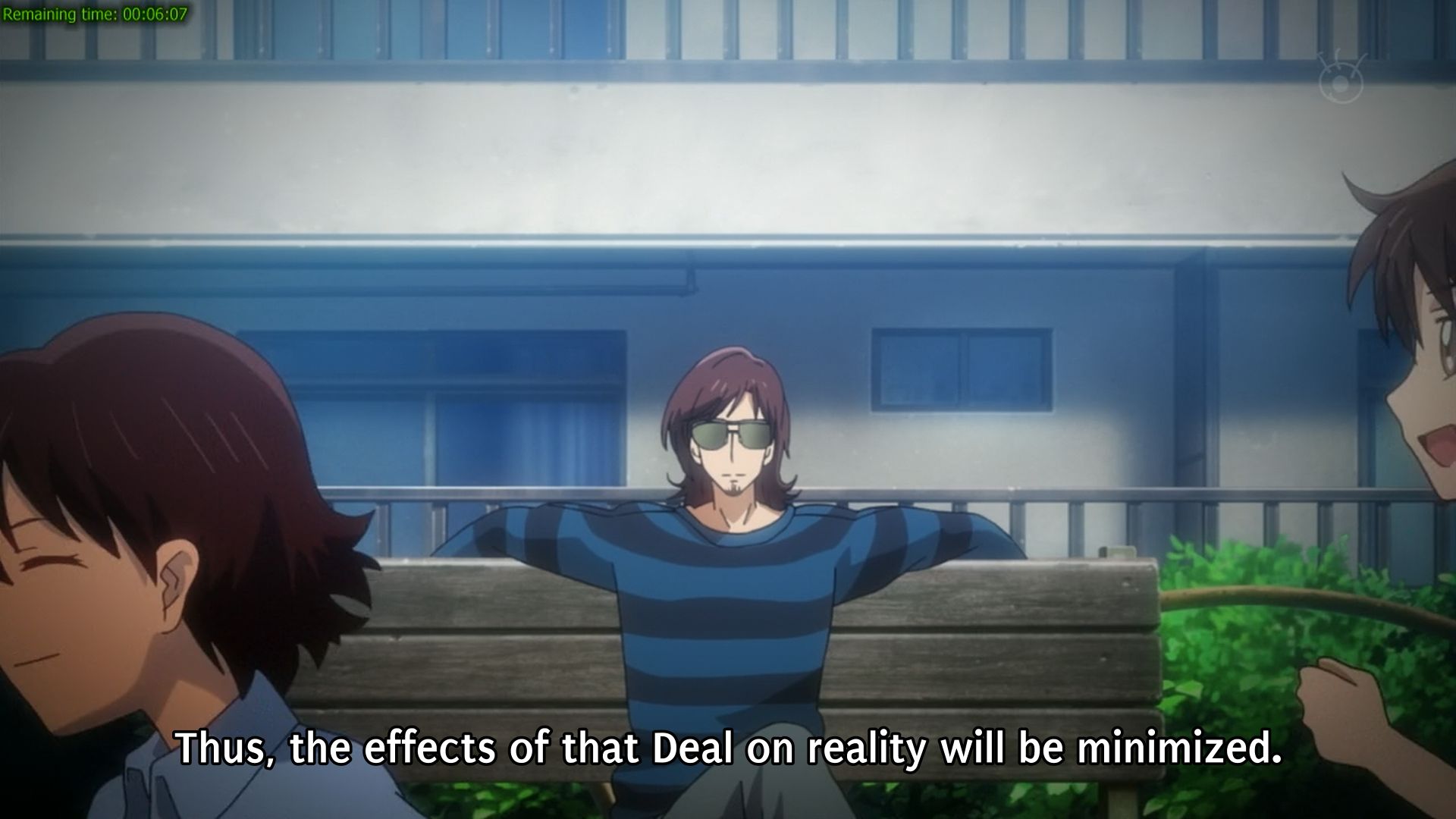
This anime has low amount of recurring characters. Unlike Tiger and Bunny, characters in this anime doesn’t really stand out to help drive this series forward, with this anime being more story-driven instead of being backed up by powerful and interesting characters. The two main characters depicted in the screenshots in this blog post are not exactly inspirational, and this would have helped this anime more if they are.


The main antagonist of this anime. While not hoisting the Keynesian flag behind the scenes of Japan's executive branch, he can be seen loitering at the local park staring at little kids.

Character Design:-
Character designs in this anime reminds me of Ookiku Furikabutte a lot, especially for the design of main protagonist. This is not a bad thing though. Anyway, the designs in this anime is good, although just like Ookiku Furikabutte, lack of black hairs (and the abundance of brown hairs) in this anime set up in modern Japan is quite unbelievable really. Then  again, the parallel dimension thingy is unbelievable in the first place…

Voice Acting:-
Voice acting in this anime is good in general, with some excellent gigs can be heard from the main protagonist’s avatar, the moderator of the Financial District and also the main antagonist. At least there are no bad ones though.

Music:-
The OST of this anime is very good, but not so for the OP and ED themes.

Animation/Direction:-
This anime uses the blurry animation technique extensively in many slow-paced scenes throughout the series, therefore one point will be docked from the final evaluation. Apart from that, the animation quality is decent, even in fast-paced scenes. CGI and 2D integration is poorly done most of the time though. Choreography isn’t exactly good, Tiger and Bunny has done better in this aspect. The directing is mostly good most of the time, except for the handling of the ending’s presentation.

Conclusion:-
8 out of 10.
A decent card-based battle if you ask me. Can be inaccessible though for those who doesn’t have a degree in economics. Tiger & Bunny passed its first challenge with flying colors.

Shortlink: http://wp.me/prgSo-x8