The blue-haired main protagonist. His name is not Kai though.

Cardfight!! Vanguard is a series I’ve glimpsed in a satellite channel I’ve subscribed to but rarely watched, Animax Asia. From the few episodes I’ve watched, I decided to get the whole shebang and watched it from the start to the finish, all 65 episodes of them. This is a 2011 title, therefore it will challenge Tiger and Bunny for the ‘Anime of the Year 2011’ title, but this series’ quest for glory will be made harder because the sport genre standard handicap will be applied here.

This series has a beach episode too. I wonder if it can be mentioned in the same breath as the Highschool of the Dead OVA is.

Story:-
The deep-blue-haired main protagonist has the hots for the brunette Toshiki Kai, a person who saved  him from his suicidal tendencies a few years back. The latter is a very lucky skillful at this thing called Vanguard card game, therefore the main protagonist decided to learn the said game too from the scratch so that the love of his life will look at him. He have to act fast though, because slowly and surely, the brunette is falling into the arms of a surly, yet beautiful white-haired card shop girl. As the main protagonist works hard at sharpening his skills in playing the Vanguard card game, he started to hear strange voices…

Vanguard is just a card game, yet it attract many shady participants...
Vanguard is just a card game, yet it attract many shady participants…
...as well as quirky ones.
…as well as quirky ones.

For the purpose of this review, knowledge of how the card game works is essential, but I don’t really feel like explaining them. What is important for you to know is how a match’s result usually decided though. In the Vanguard card game, in almost all scenarios, when the competing two players are roughly equal in skills, tactics’ execution and deck constructions, the result will always be determined on which player has the most luck when it comes to drawing trigger cards. Actually, this anime even admitted it as such. In other words, luck plays a hugely disproportionate role in determining a match’s result. Skills only comes to the fore only if the participants isn’t on the same level (skill + tactic + deck construction), an occurrence that is not exactly common in this title.

What this means here is that the major directions of the storyline are determined by the most important plot device in this series: the 4 Vanguard trigger cards. Personally, I think the writer uses this plot device very well to steer the direction of the main plot the way he/she wanted it. As you may suspect, the trigger cards is a fertile source for deux ex machina moments (the third battle of the finale is such a fine example of this) but the writer really minimized the damage that such moments can do to the series.

OMG!! DRAMA!
OMG!! DRAMA!

As for the story itself, it is quite decent but not exactly a masterpiece. It is your standard ‘I wanna be stronger’ plot common for the genre if when its protagonist is a complete newbie at the start of the series. What grates me about the storyline the most is the existence of a couple of forced drama scenes (an example can be seen in the above screenshot) and also the tendency to insert flashbacks exactly at junctures where it isn’t needed. The latter in particular has the additional effects of disrupting the flow of the plot and also slowing down the pacing, at a time when the pacing should have been quicker. And I do mention that the flashbacks are annoying right?

While the pacing in the general storyline of this anime could have been much, much better, the in-game and in-tournament pacing is largely excellent, with only some minor blips. Thankfully, those scenarios makes up the majority of this anime. Unnecessary match-ups are not shown at all, especially those that didn’t involve the main protagonist and/or his team. Matches with less importance in it that involves him or his team are done quickly too, ensuring that the pacing didn’t suffer. More airtime is given on important matches, appropriately so. And as mentioned before, the flow of the storyline has been affected by those flashbacks thingy, and this actually affect both in-game/in-tournament moments as well as the portions outside of them. This anime has a second season; hopefully this aspect can be improved in the sequel.

As for character development, a sport genre title will almost always excels in this aspect especially if the main protagonist is a complete n00b in the game that are being portrayed. The same can also be said here, with the blue-haired main protagonist being the best character with his extremely extensive character development. The aforementioned surly white-haired card shop girl is another character that is almost on the same level as the main protagonist, while the latter’s love of his life is the sore exception in the team with his nearly static character development. The ending is decent and admittedly predictable, and it is written to accommodate a second season that is already airing. I wonder if Animax Asia will have that one or not.

This anime need less of this shit...
This anime need less of this shit…
...and more of the fast-paced national tournament goodness.
…and more of the fast-paced national tournament goodness.

Character Design:-
Character design in this anime is just your common shounen genre designs, orthodox ones if you ask me. Therefore, do not expect to see many black-haired characters in this anime set up in card-crazed modern Japan. Instead, the manufacturers of hair dyes are swimming in mountains of yen as people with blue hairs or white ones or more commonly, many shades of brown makes up the majority of the characters in this anime.

Voice Acting:-
The quality of voice acting in this anime is uneven. The blue-haired main protagonist and his black-haired future brother-in-law is just average, while the brunette and the white-haired card shop girl is just a little bit better than them. Three outstanding voice acting jobs in this anime belongs to the main protagonist’s little sister (has orange hair – dammit, it is orange), the redhead antagonist and also Daimonji Nagisa (another brunette). Thinking about that, the main protagonist sure sound better when he is in that SEED mode!

Music:-
This anime has done really well in this aspect. Not only the OST is decent, but the majority of the OP and ED themes are actually good. After the below average 1st OP and ED themes, all themes that follows them (2nd OP theme and 2nd, 3rd and 4th ED themes) are actually good.

The blurry animation technique in action in this anime.

Animation/Direction:-
This anime used the blurry animation technique extensively throughout the series as illustrated in the screenshot above, mostly in fast-paced scenes. Therefore, one point will be docked from the final evaluation of this anime.

Another complaint I have for this anime in this aspect is the poor character animation quality. I mainly refer to its atrocious character animation frame rate, which can be likened to a slide-show at its worst. This happens mostly outside card battles though, and not in them.

Non-character animation quality is good, and so is the overall animation in in-game matches, even in fast-paced scenes. Choreography is just average though, what do you expect from a card game anime? The director can be credited for not resorting to the potentially finicky CGI animations and pacing management in in-game events. The staggered flow of the storyline is another matter though.

Conclusion:-
5 out of 10
. The various handicaps this anime has really drag a reasonably enjoyable sport genre title down. Tiger and Bunny passed its second consecutive challenge very nicely as a result.

Speaking about music, if I am the manager in charge of this idol group, I will make them go to plenty of choreography classes. This is definitely the worst idol group in anime history.

Shortlink:
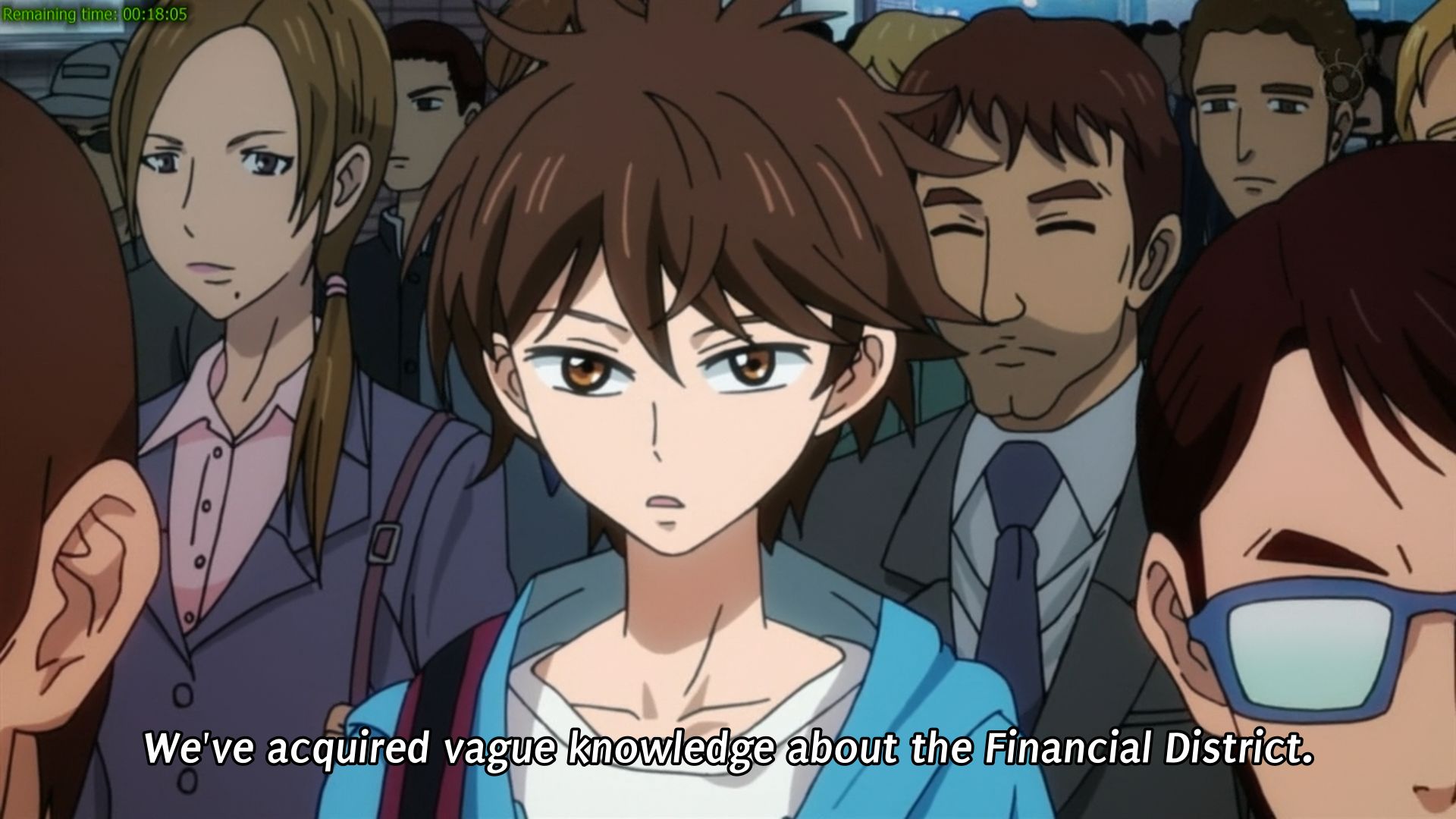

The main male protagonist, holding the fort for Milton Friedman on behalf of International Monetary Fund. IMF in this anime sure is different than the one in real-life.

Tiger and Bunny has just managed to win the ‘Anime of the Year 2011’ title in the last post, and today it has to defend the title against yet another 2011 anime series that I have decided to watch, titled C – The Money of Soul and Possibility – Control. This anime features a never-seen-before concept as the core of its plot, and this results in this anime's failure to unseat Tiger and Bunny’s reign after only one post.

Story:-
Set up in Japan that is under economic and social disarray, our equally struggling main protagonist was randomly selected by a mysterious clown-like person to participate in a series of battles taking place in an alternate dimension. The prize for winning (or not losing too heavily) is money, with his ‘future’ being put up as the collateral for participating in those battles. After winning his first battle completely by pure luck, the main protagonist met with one of veterans of the said game, who seems to be oddly interested in him (not THAT way though).

Take a few characters from the .hack//G.U series (plus significant amount of its plotline), transplant them in a Gantz-like world (use many of its technical structures), then add a couple of plot devices from the Cardfight!! Vanguard anime (the card and the avatar for example), and you will get an anime series that has plenty of battles. But instead of having a ‘save the world’ or ‘good vs. evil’ plots, this anime features prominently a thinly-veiled war between Milton Friedman and John Maynard Keynes macroeconomic principles, where the stake is the existence of Japan itself.

This is where the first weakness of this anime will become more apparent. Unless you are well-versed with both of those two luminaries’ economic principles, there are chances you won’t get to fully understand this anime’s storyline. It can be argued that having the clash between two important economic principles in the plot  can make a great storyline, but the risk of making the storyline itself inaccessible because of that is also high. I vastly prefer the way Wolf and Spice does its business, where its microeconomic principles are explained and integrated in its storyline in a way that even a dumb-ass can understand and enjoy. There are reasons why the two seasons of Wolf and Spice do get the perfect score designation after all.

Considering that I do know how the two macroeconomic principles works in general, I do thoroughfully enjoys this series. The usage of plotlines lifted straight from .hack/G.U. (the little sister sub-plot pretty much confirms it) and combined with the aforementioned clash between economic principles, this results in a pretty solid anime title. The pacing of the storyline is excellent, but  there are some problems with flow of the story due to repeated use of Katanagatari-esque off-screen battles. What I don’t really like in this anime is that sometimes it shows the main protagonist preparing to battle a foe at the end of an episode, then when the next episode plays, no results from the said battle is being conveyed to the audience at all.

The other weakness of this anime is the ending. Just to make it clear here, this anime’s ending by itself, is quite good, despite being inherently predictable. But some minor plotholes remains after the final episode stopped playing, an example being the like the outcome of the battle between the IMF mole in the guild and one of main antagonist’s lieutenants. This anime is the kind that need the kind of ending that Kore wa Zombie Desu ka? has the most; a complete episode dedicated solely for the aftermath. I think there is a series that does exactly just that, but I cannot remember which one. The paltry 2 minutes airtime dedicated in this anime to show what happened after the main protagonist saves Japan is simply not good enough.

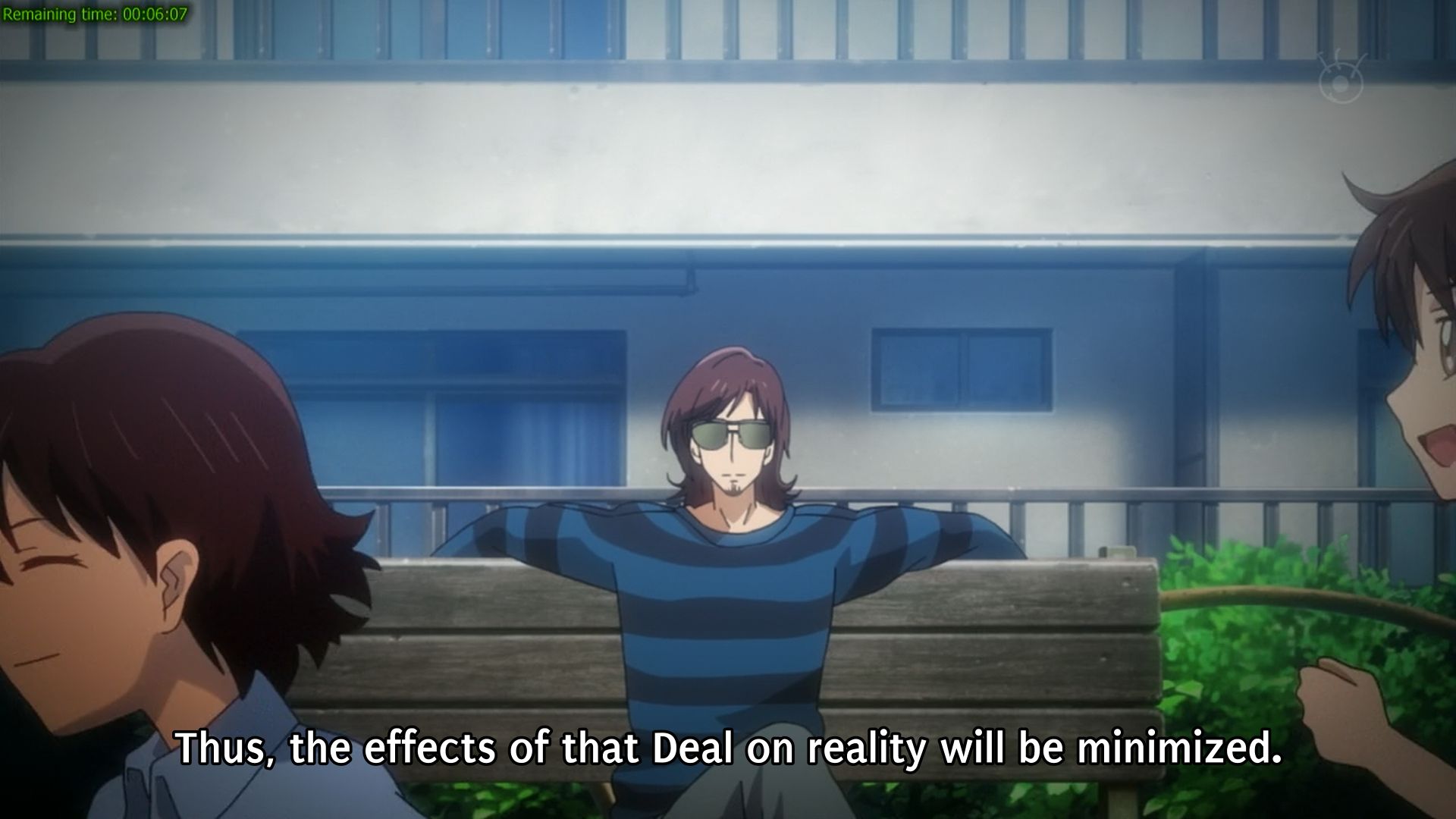
This anime has low amount of recurring characters. Unlike Tiger and Bunny, characters in this anime doesn’t really stand out to help drive this series forward, with this anime being more story-driven instead of being backed up by powerful and interesting characters. The two main characters depicted in the screenshots in this blog post are not exactly inspirational, and this would have helped this anime more if they are.


The main antagonist of this anime. While not hoisting the Keynesian flag behind the scenes of Japan's executive branch, he can be seen loitering at the local park staring at little kids.

Character Design:-
Character designs in this anime reminds me of Ookiku Furikabutte a lot, especially for the design of main protagonist. This is not a bad thing though. Anyway, the designs in this anime is good, although just like Ookiku Furikabutte, lack of black hairs (and the abundance of brown hairs) in this anime set up in modern Japan is quite unbelievable really. Then  again, the parallel dimension thingy is unbelievable in the first place…

Voice Acting:-
Voice acting in this anime is good in general, with some excellent gigs can be heard from the main protagonist’s avatar, the moderator of the Financial District and also the main antagonist. At least there are no bad ones though.

Music:-
The OST of this anime is very good, but not so for the OP and ED themes.

Animation/Direction:-
This anime uses the blurry animation technique extensively in many slow-paced scenes throughout the series, therefore one point will be docked from the final evaluation. Apart from that, the animation quality is decent, even in fast-paced scenes. CGI and 2D integration is poorly done most of the time though. Choreography isn’t exactly good, Tiger and Bunny has done better in this aspect. The directing is mostly good most of the time, except for the handling of the ending’s presentation.

Conclusion:-
8 out of 10.
A decent card-based battle if you ask me. Can be inaccessible though for those who doesn’t have a degree in economics. Tiger & Bunny passed its first challenge with flying colors.

Shortlink: http://wp.me/prgSo-x8

     This anime’s main protagonists, Wild Tiger and Barnaby Brooks Jr. Bunny!

Surprisingly, you don’t have to wait for a month for this review, unlike the last one for Sacred Seven. The main reason why this happens is because the anime I’m going to write about in this post is just so awesome, I can’t help myself from watching the second half of the series in less than 24 hours. It has been quite some time since I do such a thing. Years maybe? If you somehow managed to skip the headline above, the anime I’m talking about is titled Tiger and Bunny, a 2011 title that will definitely give Highschool of the Dead OVA some serious competition for the Anime of the Year 2011 title. Will we see a new winner here? Read on to find out.


Sometimes, the best character of this anime cheated on his partner and went out fighting terrorism with a sweet young thing instead!

Story:-
Some time in the future (kinda like Sacred Seven), humans that has special powers due to gene mutations (hmmm… sure smells like Sacred Seven) are common. Some of them participates in the local city’s superheroes reality TV program, where their powers are used to defend the population from criminals and terrorists, scoring points during the jobs. Being superheroes, wearing masks and armors is a must (Sacred Seven reference here guys?) complete with brand placements from major sponsors (Squall Leonhart will not deign himself to such capitalistic ways of life). Our first main title male protagonist, a 10-year veteran at the show, was forced to be paired with an up-coming starlet (the second main title protagonist) who has the same exact powers as him.  While their powers is the same, their goals in life isn’t, and this clash of personalities makes up one of the many faces that this anime has.

After watching this anime until the end in only 3 days, I can confidently say that this anime is Sunrise’s answer to Gainax’s Tengen Toppa Gurren Lagann, a hugely popular 2007 anime. In fact, I can also confidently say that this anime is better than the latter, for reasons that will be explained later below.

 
Well sometimes he also play the 'Most Wanted' game too.

What makes Tengen Toppa Gurren Lagann (abbreviated TTGL from now on) very good (it scored a perfect score for the record) is that while it has a typical kiddy-grade storyline, almost all of the clichés and weaknesses of the associated genre has been eliminated, making TTGL watchable for people outside the genre’s usual demographics. The same polish can also be seen in this anime, but this anime has the advantage of having a considerably superior general storyline based on a more mature shounen genre aimed for middle and high school students.

As for this anime’s storyline itself, it is a cross of Tantei Gakuen Q’s prevailing main plot (with the homicides investigation cases being replaced with superheroes stuff) and some Blassreiter-esque action flick (minus the presentation problems), sprinkled with heavy doses of comedy and slice-of-life elements. The first half of the series is filled with plenty of Bleach-like fighting, while the second half is more Enemy of the State-like conspiracy thriller than anything else. While better than TTGL’s general storyline, on its own this anime’s storyline is not exactly a masterpiece. For example, the thrilling second-half of this anime is not as good as One Outs. Even that, other factors more than make up for it, which will be explained below. Just like the anime version of Tantei Gakuen Q, the prevailing plot is not over yet after the last episode ends, therefore a second season should be in order. But the transformation of one of the main title protagonists is radical, on par of his counterpart in Kuroshitsuji, therefore if a sequel comes out, the writing has to be very solid in it to accommodate the change in his characterization.


Just one of the hazards of the superheroes job.

The presentation in this anime is pretty much spot-on. The pacing is perfect, and I cannot even attempt to nit-pick on it even if I tried. Why is that Sunrise cannot do the same for Sacred Seven, I don’t know. The flow of the storyline is also the same, no scene transition problems unlike what what have happened in Sacred Seven. It also helps that the writer actively reuse story elements introduced in early parts of the anime effectively in later episodes, eliminating virtually all loose ends. This kind of foresight is what made the likes of One Piece and The World God Only Knows manga really good.

Just like in TTGL, character developments is a strong point for this anime. In fact, I personally think this anime does it even better than TTGL did. Unsurprisingly, the two main title protagonists are the most important characters in this anime, with the older character just  edged ahead of the younger character in the end as the best character in this anime, mainly because of his Kuroshitsuji-esque transformation. And unlike TTGL, these two powerful characters were ably assisted by many excellent secondary characters, such as the other participants of the reality program, the producer of the said program and even the antagonists of this anime. And of course, I have to mention the Macross 7 flower lady rip-off character that seems to be everywhere in the city, that is governed by an Obama-like mayor too.


This superhero job is far easier though.

Character Design:-
Yet again, not exactly too different compared to the last Sunrise anime title reviewed in the last post. The only thing that is different from Sacred Seven is that this anime has more variety in those character designs. For example, this anime has bishounen characters while, Sacred Seven doesn’t. Superheroes costume designs are all decent at least, none of the crap seen in Sacred Seven like the protagonist’s final form.


If you ask me, the city where this anime take place has more crime problems than Gotham City.

Voice Acting:-
This section is another part where this anime has done better than TTGL, and Sacred Seven for the matter. The older main title male protagonist voice actor has the best voice acting gig in this anime, and the other main title protagonist’s voice actor also has done an above average job too. Other notable gigs in this anime includes the antagonist of the first arc, his subordinate (the female one) and the superhero that can use wind.

Music:-
The OST is decent, but not as good as the one in TTGL. The 1st ED theme and 2nd OP theme is excellent though.


Their budding relationship that the writer utilized to try to steer this anime into yaoi genre is one of the highlights of this anime.

Animation/Direction:-
The animation quality in this anime is good, even in fast-paced scenes. This is comparable to Sacred Seven, but somewhat inferior to TTGL. One good inconsistency between the two Sunrise titles is that this anime doesn’t use the blurry animation technique that the other one has, so no mandatory point docking will be performed. 2D and CGI integration is seamless. Choreography in action scenes is just average though, both TTGL and Sacred Seven are better than this anime in this aspect. The directing is excellent just like it does in TTGL, for exactly the same reasons too, which is mainly the moderating the common clichés commonly seen in the genre the storyline is in, having strong characters in the storyline itself and perfected presentation.

Conclusion:-
10 out of 10
, which means we have a new ‘Anime of the Year 2011’ title holder. While TTGL has the bad luck of being pitted against the stupendously awesome Nodame Cantabile S1 five years ago, this beach episode-free series has more luck because it has only to contend with a 15-minute beach episode OVA featuring hips that moves on its own.


English in this anime is quite decent.

Shortlink: http://wp.me/prgSo-x2